
Architectural Ethics: The Silent Story
How the Built Environment Speaks Without Words
Architecture does not need language to communicate. It speaks through height, distance, material, light, access, and control. Long before a person understands zoning codes or planning theory, they feel architecture—who it welcomes, who it excludes, and who it protects.
Cities tell stories silently. And some of the most powerful stories are ethical ones.
Architecture Is Never Neutral
Every building answers questions, whether the designer intends it or not:
-
Who belongs here?
-
Who is allowed to pass through?
-
Who is protected?
-
Who is exposed?
When these questions are answered consistently across an entire city, architecture becomes more than shelter. It becomes a system.
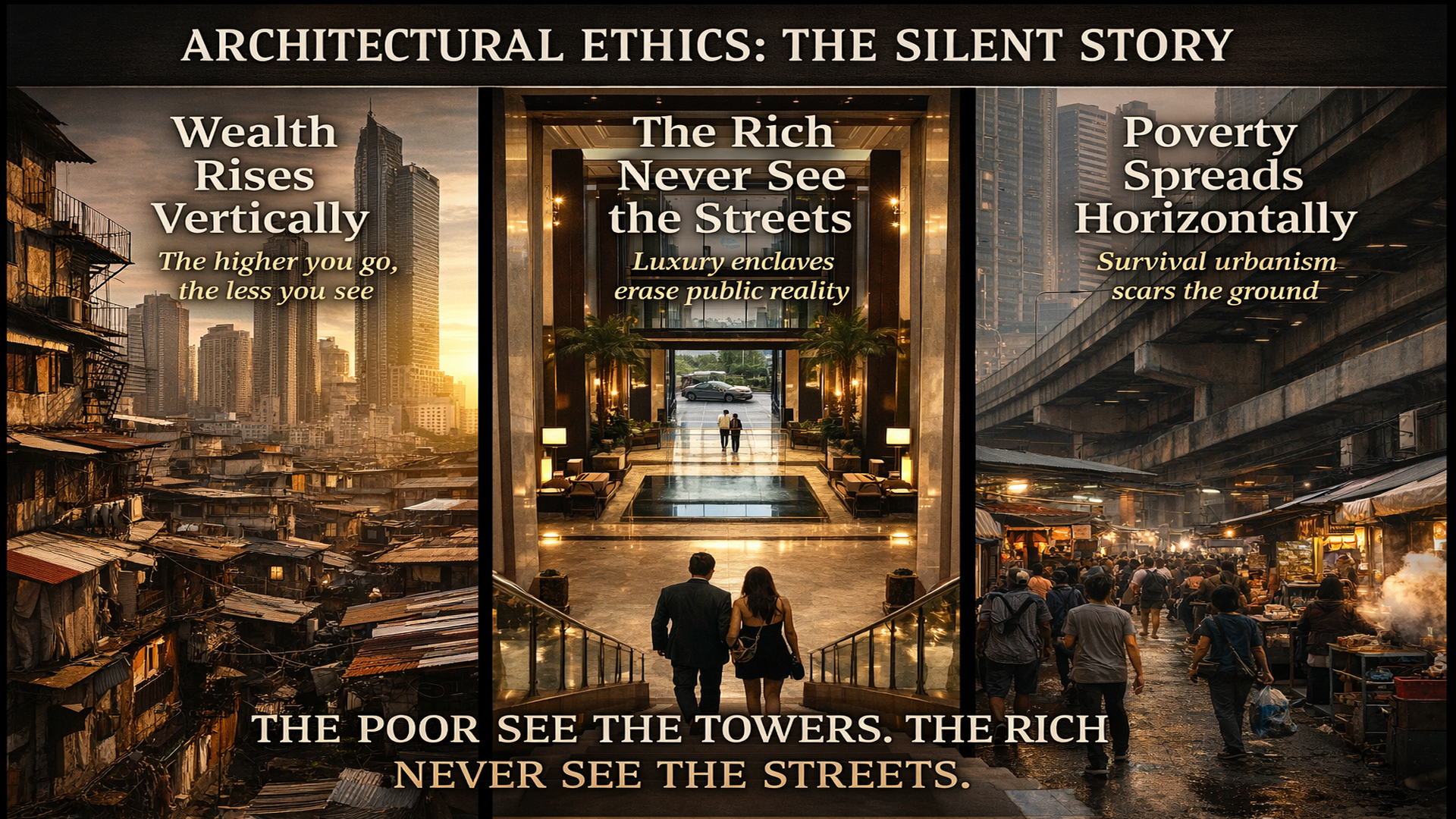
Wealth Rises Vertically
In many cities, elevation correlates with privilege.
The higher you go, the quieter it becomes. Air improves. Views expand. Access narrows. Elevation separates people from noise, congestion, and social friction. Verticality becomes a filter—not just of sound and light, but of reality itself.
This is not density for efficiency.
This is height as insulation.
Architecture lifts wealth away from the conditions that sustain it.
Poverty Spreads Horizontally
At ground level, the city compresses.
Housing expands laterally into tighter footprints, narrower streets, and overcrowded interiors. Growth happens through additions, improvisations, and informal adaptations rather than through planned expansion. Space is negotiated, not granted.
Horizontal density becomes a symptom of exclusion rather than choice.
This is not organic urbanism—it is survival urbanism.
The Visible Divide
From the street, symbols of power are always present.
Large structures dominate skylines, reminding people daily of systems they cannot access. Visibility flows in one direction: upward. Those at the bottom are constantly aware of what exists above them.
Architecture becomes psychological.
Buildings are no longer just physical objects—they are reminders of hierarchy embedded into everyday life.
The Disappearance of the Street
From above, the city often disappears.
Controlled lobbies, private circulation, secured entrances, and separated transit paths allow certain users to move without ever engaging public space. Streets—where complexity, conflict, and human reality exist—are designed out of the experience.
When architecture removes encounter, it also removes accountability.
Architecture as a Social Sorting Machine
Over time, the built environment begins to sort people automatically:
-
Height sorts wealth
-
Access sorts privilege
-
Light sorts value
-
Visibility sorts power
No enforcement is required.
No policy announcement is necessary.
The city itself performs the sorting.
This is architecture operating as infrastructure for inequality.
The Erosion of Public Space
True public space becomes rare.
What appears public is often privately owned, surveilled, and regulated. Civic life moves into leftover spaces—streets, markets, rooftops, and edges—where people negotiate belonging informally.
When public space disappears, architecture quietly abandons its civic responsibility.
Why Architectural Ethics Matter
These conditions do not emerge from aesthetics alone. They are the result of decisions:
-
What gets funded
-
What gets regulated
-
What gets prioritized
-
What gets ignored
When design answers only to capital, speed, or efficiency, ethics are not removed—they are replaced.
The city begins to serve systems instead of people.
An Ethical Reminder for Designers and Builders
Every project carries moral weight.
Not because architecture can solve social problems alone—but because it can lock them in place.
Ethical architecture asks difficult questions early:
-
Who gains access?
-
Who loses light?
-
Who bears the risk?
-
Who is never considered?
Closing Thought
When architecture stops asking who it serves, it quietly decides who it excludes.
The silent story is always being written.
The only question is whether we choose to read it—or redesign it.